If you’ve ever suffered through sluggish airplane Wi-Fi while trying to send a simple email at 35,000 feet, Southwest Airlines has some good news for you.
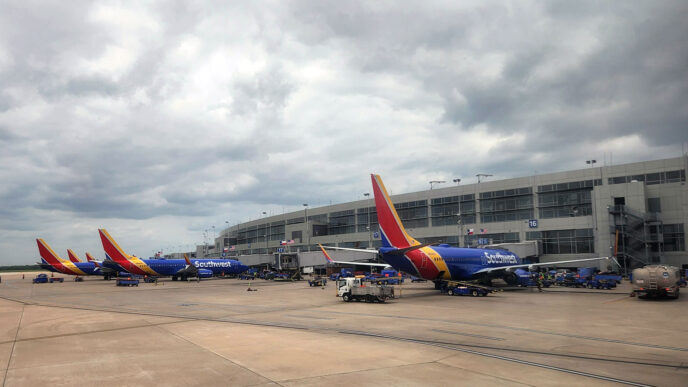
The carrier has put its first Starlink-equipped aircraft into service, a Boeing 737-800 with tail number N8543Z, which completed its inaugural flight on June 22, connecting Dallas Love Field with Albuquerque, New Mexico. It’s a small step in terms of fleet size, but a big one in terms of what travelers can actually expect onboard.
What Makes Starlink Different
Legacy in-flight Wi-Fi has always been something of a compromise. Connections were slow, video calls were a pipe dream, and streaming anything beyond a low-res YouTube video was mostly wishful thinking. Starlink flips that on its head.
Starlink’s advantage over traditional in-flight Wi-Fi comes down to its satellite network. It orbits much closer to Earth than conventional satellite internet, resulting in lower latency and significantly faster speeds. According to Starlink, the aviation service delivers download speeds between 135 and 310 Mbps, with peak bursts of up to 450 Mbps. Upload speeds run 20 to 44 Mbps, and latency typically stays under 99 milliseconds. That’s enough headroom for 4K streaming, video calls, and live gaming, simultaneously, across a full cabin.
How Much Will It Cost You
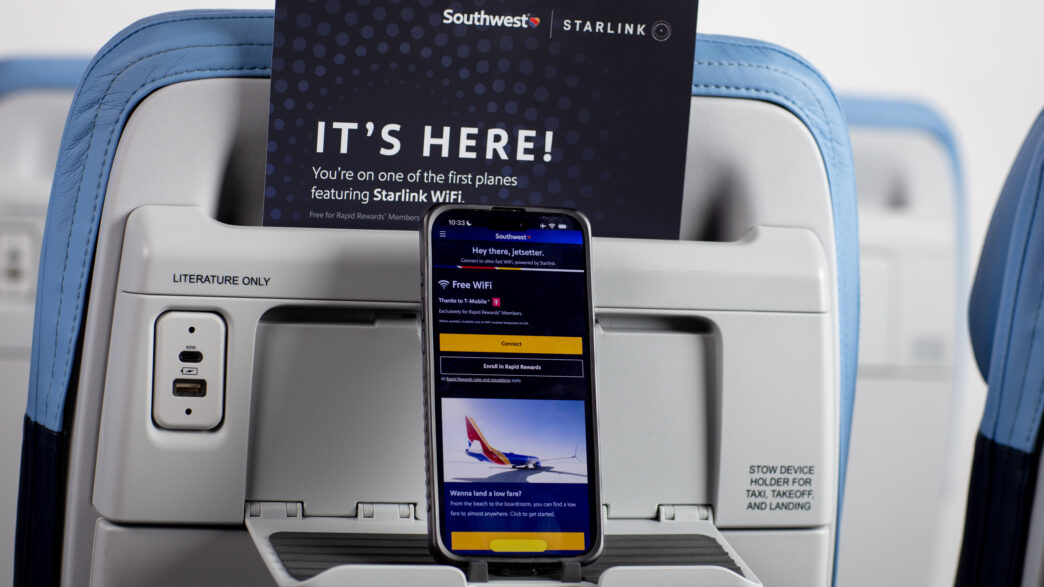
Members of Southwest’s Rapid Rewards loyalty program get Starlink Wi-Fi at no charge. Non-members can purchase access for $8 per device, covering the flight from takeoff to landing. For context, legacy in-flight Wi-Fi on competing carriers has historically cost $20 to $30 per flight with a fraction of the performance, so even the paid tier is competitively positioned. Southwest is following other legacy carriers by introducing free Wi-Fi for rewards members as well.
For frequent flyers who are already Rapid Rewards members, this is basically free broadband in the sky.
The Bigger Picture
The launch marks the first phase of a large-scale modernization effort that will eventually reach hundreds of aircraft. Southwest plans to have Starlink available on more than 300 aircraft by the end of 2026, and eventually aims to install the technology across the entire fleet.
Southwest isn’t alone in making this move. Hawaiian Airlines was the first US carrier to deploy the system, and United Airlines has begun installations on its regional and mainline aircraft. Delta and American currently rely on a mix of Viasat and Intelsat services, though both have been upgrading hardware to deliver faster speeds.
The shift to satellite-based connectivity has implications beyond passenger comfort. Crews can use the same systems for real-time operational data, weather updates, and even electronic flight bag synchronization, potentially making flights more efficient overall.
What It Means for Travelers
For anyone who travels regularly for work, or who just wants to stay connected without paying a premium for mediocre service, this is genuinely exciting news. Whether you’re hopping from Chicago to Denver or catching a quick flight from LAX to Seattle, decent in-flight Wi-Fi makes the journey feel a lot less like dead time.
For more information, visit southwest.com.