

If you’ve ever navigated the cramped, confusing corridors of New York Penn Station, you already know the experience leaves a lot to be desired. For decades, it has been the butt of jokes, the subject of frustrated social media posts, and a genuine source of stress for hundreds of thousands of people every single day. That may finally be about to change.
Amtrak and Penn Transformation Partners (PTP) have officially signed a Pre-Development Agreement (PDA), marking a major milestone in the effort to transform the busiest transit hub in the Western Hemisphere into a world-class station. Groundbreaking is targeted for before the end of 2027.
Who Is Building This Thing?
PTP is a joint venture led by Halmar and Skanska, two firms that bring extensive experience building large-scale, complex transit infrastructure. Their resume includes the award-winning LaGuardia Terminal B Redevelopment project and the PATH World Trade Center station, as well as the successful delivery of Moynihan Train Hall and the LIRR 33rd Street Concourse. In other words, these are people who have already worked in and around Penn Station and know what they’re getting into.
The project is structured as a public-private partnership (P3), a model in which the private sector assumes additional responsibilities and risks while bringing private capital, efficiency, and expertise to the project.
What Will Actually Change?
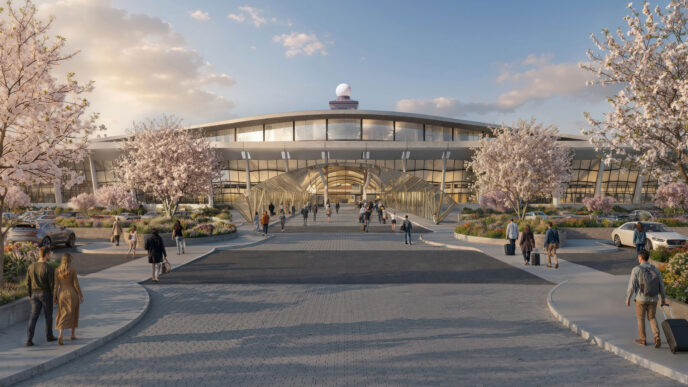
This is where things get genuinely exciting. The new Penn Station will feature a single-level concourse of stone and bronze with soaring ceilings, with all public activity consolidated on one floor, including amenities, bars, restaurants, shops, and customer services.
Riders and visitors will benefit from new entrances, including a grand Eighth Avenue entrance, expanded pickup and drop-off areas, wider sidewalks, and the replacement of cramped walkways with open, beautiful concourses. The project also includes beautifying the surrounding streets and sidewalks to improve the pedestrian experience.
One of the most significant improvements for transit riders is the expansion of track capacity. The plan calls for at least limited through-running on the regional rail network, meaning trains wouldn’t necessarily terminate at Penn Station but could continue beyond it to other stops. This has been a long-sought goal for transit advocates and would dramatically improve the flow of NJ Transit and Long Island Rail Road service.
Madison Square Garden will not be moved. However, the Hulu Theater (Infosys Theater) will be demolished to make way for the grand new Eighth Avenue entrance to the train hall.
The Design Vision
The new design takes inspiration from the original Penn Station, the classical structure that was controversially demolished in the 1960s, while fitting in with the major structures currently on site, particularly Madison Square Garden and Moynihan Train Hall. The goal is a station that feels both historically rooted and unmistakably modern.
The completed station will reduce congestion, eliminate dead ends, improve visibility, and expand waiting areas throughout. Whether you’re a New Jersey or Long Island commuter, an Amtrak traveler, a concertgoer heading to MSG, or just a neighbor trying to navigate the area on foot, the experience is meant to be dramatically better from every angle.
How Much Will This Cost?
The transformation is currently estimated to cost between $7 and $8 billion, with final costs to be determined during the pre-development phase. The project will be funded primarily through federal funding, private financing, and equity raised by PTP. Importantly, Amtrak has confirmed there will be no fare hikes or surcharges passed on to NJ Transit, MTA, or Amtrak riders to pay for this project.
What Happens Now?
During the PDA phase, the project team will finalize the design, gather stakeholder input, and establish a firm, fixed price for the work. From summer 2026 through 2027, Amtrak will conduct a robust public engagement process as it works through design development, financial plans, and environmental review, with no final decisions made before the public has a chance to review and comment.
A Penn Station Working Advisory Group comprising more than 50 organizations representing local stakeholders and community groups has been part of the process since 2024.
For a station that serves hundreds of thousands of people daily, the stakes couldn’t be higher. But for the first time in a long time, there’s a real plan, a real developer, and a real timeline. Penn Station’s era of being the worst-in-class experience in American transit may have a genuine expiration date.